
The Department of Clinical Epidemiology at MDRF, established in 2011, plays a vital role in strengthening evidence-based practice by applying epidemiological methods to real-world clinical problems. Clinical epidemiology supports clinicians in addressing the challenges and uncertainties encountered in medical practice through scientifically designed studies that generate reliable, actionable insights.
The department is dedicated to improving health outcomes by conducting high-quality research involving patients, clinical settings, and the broader healthcare system. Its work bridges clinical medicine, public health, and the social sciences to better understand disease patterns, healthcare delivery, and the effectiveness of interventions. By integrating rigorous scientific methods with practical clinical needs, the Department of Clinical Epidemiology aims to enhance health services management, inform policy, and prepare for emerging clinical challenges.
ChatGPT said:
The Department of Clinical Epidemiology, established in 2011 under the leadership of Dr. C. S. Shanthi Rani, is committed to advancing clinical research that empowers healthcare professionals to address real-world medical challenges through scientifically designed studies. The department focuses on improving health outcomes by conducting research involving patients and healthcare systems, fostering a deeper understanding of disease patterns and treatment effectiveness. With a vision to bridge health and social sciences, it strives to enhance health services management and prepare for future clinical challenges through evidence-based, impactful research.

Dr.C S Shanthi Rani
The study has been planned with the following clinical setting:
- There is increased preference for newer therapies like DPP4 inhibitors, GLP-1 agonists and SGLT2 inhibitors with proven robust data and as drug choice of newly diagnosed patients supported by key international guidelines.
- Also, physician prefers voglibose over acarbose for postprandial glucose (PPG) management considering that both are similar in mode of action.
- The effect of acarbose on gut microbiota has been evaluated in prediabetes and T2D patients in China. However, there is a need of generating data to see the effects of acarbose monotherapy and in combination with metformin on microbiota of Indian diabetes patients for better acceptance.
The aim of the study is to explore the effect of acarbose monotherapy or acarbose/metformin comination treatment on the modulation in proportion and diversity of gut microbiota as compared to baseline and to demonstrate the beneficial effect of acarbose monotherapy or acarbose/metformin combination treatment on blood glucose control, glycemic variability, inflammatory markers, serum insulin level, lipid profile and body weight as compared to baseline
Chennai Urban Rural Epidemiological Study Follow up (CURES)
Chennai Urban Rural Epidemiology Study (CURES), started in 2001, is a large epidemiologic study involving a representative population of Chennai with the main objective to estimate the prevalence of diabetes and its complications in urban Indians and to identify the risk factors for non-communicable diseases (NCDs).CURES study-10 year follow up study (prospective study) which helps in measuring the incidence of the diabetes, pre diabetes, mortality, depression with and without diabetes and its complications (retinopathy, nephropathy, neuropathy, peripheral vascular disease and coronary artery disease).The Indo- Danish MicrobDiab trial, on the role of gut microbiota in prediabetes and type 2 diabetes
A Customizable and Intelligent Artificial Pancreas for Type-1 Diabetic Patients of India and a Cost-Effective Insulin Pump
The Smartphone based AP system developed by IISC (Prof. Padhi) and his team consisted of five different hardware, namely a CGM sensor, a blucon ambrosia, an Android Phone, a Riley Link and finally a commercially available insulin pump. Technologies such as system identification, sensor calibration, state-estimation, safety-critical unscented model predictive control, android app development to communicate with other hardware components and embed the control system algorithm, which are inherent components of this system, have already been developed and tested. However, the current project is to develop a Smart and sophisticated Artificial Pancreas (AP) system and a cost-effective Insulin pump and to develop a cost-effective and certifiable insulin pump (based on the already developed patented and animal tested drug delivery device).
Noninvasive Type 2 Diabetes Screening: Clinical Evaluation of SCOUT DS in an Asian Indian Cohort
The first clinical study was “Noninvasive Type 2 Diabetes Screening: Clinical Evaluation of SCOUT DS in an Asian Indian Cohort” has several advantages over fasting plasma glucose and/or A1C for mass diabetes screening. Novel low – cost technologies for diabetes screening and treatment. PATH study – a population based study to identify the “Novel low – cost technologies for diabetes screening and treatment”.
Assessment of Diabetic Retinopathy in Type 1 Diabetes in south.
Pioneer to have conducted various clinical researches in type 1 diabetes and the long-term survival patients with type 1 diabetes. Assessing the diabetic retinopathy in type 1 diabetes in South Indians and to increase the awareness about Diabetic Retinopathy among the parents and people with type 1 diabetes.
Evaluation studies of New Device for diagnosing peripheral neuropathy (ENDURO)
The ENDURO study to perform screening of the patients for Diabetic Peripheral Neuropathy using the Neurotouch device and analyze the results comparing to the conventional devices. We do various clinical research in type 2 diabetes and its complications.
Natural History, Survival and Follow Up of patients with type 1 diabetes in India
Type 1 diabetes (T1D) study was established the Natural History, Survival and Follow Up of patients with type 1 diabetes in India and also to establish a type 1 diabetes registry at DMDSC and MDRF and a system to closely follow up these patients over the next 5 to 10 years to improve their diabetes control and thereby their general health.
Important Events
- The Clinical Epidemiology Department at MDRF presided over the World Diabetes Day function held on November 14, 2011. During the event, the website for the “Neonatal and Monogenic Diabetes Registry” was officially inaugurated. The function was graced by the presence of several distinguished guests, including Mr. Prashanth (Film Actor), Dr. P. Jeyachandran (Director & Superintendent, Institute of Child Health and Hospital for Children), and Dr. V. Poovazhagi (Assistant Professor, Department of Pediatric Intensive Care & Diabetes Clinic, Institute of Child Health and Hospital for Children).
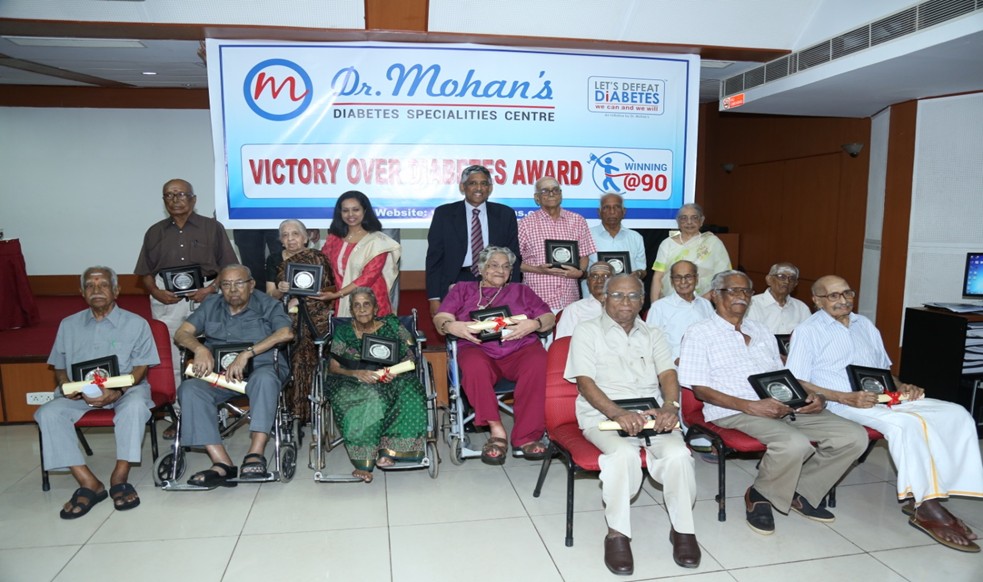
- We Clinical Epidemiology Department at MDRF initiated a first-of-its-kind award to recognize healthy elderly individuals with diabetes aged over 90 years. In an effort to celebrate and encourage Indian nonagenarians who have successfully managed diabetes over several decades, the awards served as a platform to honour more than 20 exceptional individuals who have lived beyond 90 years. This initiative highlighted the significance of an active lifestyle supported by a balanced diet, regular exercise, routine medical check-ups, and timely medication. It also aimed to dispel the common myth that diabetes necessarily shortens one’s lifespan.

Another event conducted by Clinical Epidemiology Department, at MDRF, organized a special event to raise awareness about the various forms of Monogenic Diabetes. The event featured young patients who are successfully managing their condition, sharing their personal experiences and emphasizing the importance of accurate diagnosis of these relatively rare forms of diabetes. Their stories highlighted the impact of early and precise identification in achieving better treatment outcomes. In recognition of its ongoing efforts and expertise in this field, the Indian Council of Medical Research (ICMR) has designated the Madras Diabetes Research Foundation and Dr. Mohan’s Diabetes Specialities Centre as the National Monogenic Diabetes Study Group of India.

Another event conducted by Clinical Epidemiology Department, at MDRF, organized a special event to raise awareness about the various forms of Monogenic Diabetes. The event featured young patients who are successfully managing their condition, sharing their personal experiences and emphasizing the importance of accurate diagnosis of these relatively rare forms of diabetes. Their stories highlighted the impact of early and precise identification in achieving better treatment outcomes. In recognition of its ongoing efforts and expertise in this field, the Indian Council of Medical Research (ICMR) has designated the Madras Diabetes Research Foundation and Dr. Mohan’s Diabetes Specialities Centre as the National Monogenic Diabetes Study Group of India.
Interested in collaborations ?